
The Caley Conundrum
Some thoughts and genuine optimism for Houston's maligned offensive coordinator

There’s no doubt that the Houston Texans’ defense was Super Bowl-caliber throughout the 2025 season. The pass rush was dominant, the secondary talent was enormous, and the individual talents of players like Will Anderson, Danielle Hunter, Derek Stingley and Jalen Pitre were certainly elevated by DeMeco Ryans and the defensive coaching staff. It was the type of unit that many teams before had taken all the way to a championship.
As such, it was impossible not to pay attention to the offense that never allowed that defense to matter in the way one would hope. Despite some improvements from the year prior, offensive coordinator Nick Caley and quarterback C.J. Stroud could not pilot the unit to where they needed to be.
Last season, facing a similar issue, Ryans made a conscious effort to change the offense structurally when he hired Caley away from Los Angeles. The idea with Caley was to bring modern ideas from the vaunted Rams offense, shore up structural issues in their protection scheme, and ultimately place Stroud in position to play the best football of his NFL career. The results were a mixed bag and, unfortunately, a 4-interception performance from the franchise quarterback in the Divisional Round in New England has left everyone spinning.
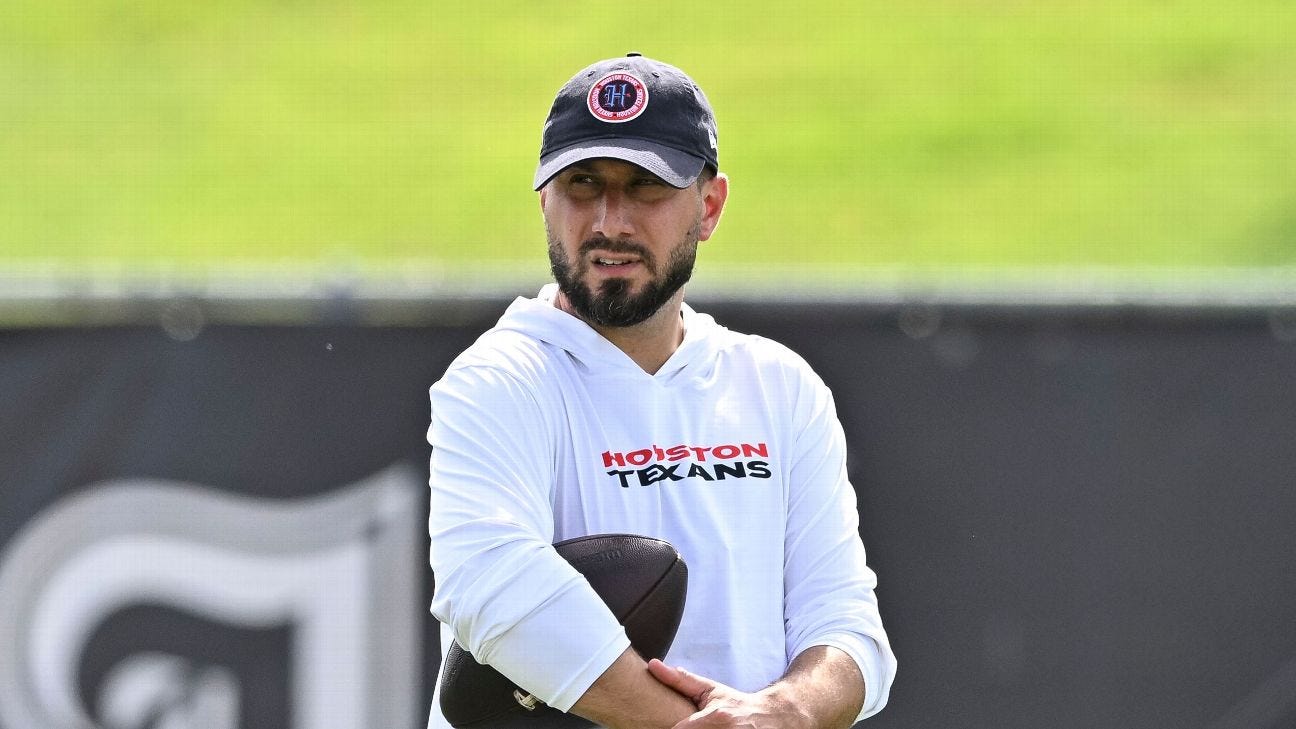
This time around, Ryans and the Texans have chosen continuity - Caley and most of the offensive staff will return and hope for improved results in year two of their offensive system. Many were clamoring for a veteran play caller to replace Caley, some for new offensive voices on the coaching staff, and others for patience and continuity.
Amidst the discussion of how best to maximize Stroud in his fourth season and put together an offense that can truly compliment the defense, I wanted to layout some thoughts on where the Texans currently sit with their offensive coordinator responsible for leading that charge.
1. Caley’s offense, if not remarkable, was structurally sound as advertised
Let’s start with the undeniable positives – Caley accomplished a bunch of stuff that he was hired to do in the wake of Bobby Slowik’s offense imploding at the end of 2024.
The protection schemes in conjunction with new offensive line coach Cole Popovich were noticeably improved and more difficult for defenses to manipulate. We saw far less sacks surrendered to unblocked pass rushers and linemen knew where they were going against most defensive fronts. Stroud was sacked less and that was without adding much, if any, talent to the offensive line (some would argue this was a worse group on paper from 2024 without Tunsil.)
The offense at times felt like the “Greatest Hits” per se of the New England-Brady era offense but they were far less predictable than what had occurred towards the end of the 2024 campaign. It was not a simple spamming of outside zone runs and in-breaking routes to Nico Collins. The run game was optimized to play based on the talent in the building rather than the ideas on paper and the shift to more “gap” runs and duo paid some small dividends and the individually called runs were sound.
In short, this was a grown-up offense in 2025. It wasn’t on the cutting edge as some might have hoped, but Caley also put together an operation that was not a disaster and allowed Stroud to play very good football prior to his concussion and eventual playoff collapse. It passed the bar to where you probably want to see a second season as players become more comfortable. Now, on the creativity front:
2. Caley does not appear to be the offensive innovator that many hoped for
On the flip side of that coin, there was real hope when Caley arrived from Los Angeles that he would be “up next” on the offensive side of the football as one of the league’s brighter young offensive minds. It has only been one season, but that feels somewhat unlikely at this point.
Houston tried their hand with a few trick plays this season and did work to follow Philly’s league trend by running the tush-push with tight end Cade Stover under center. However, those are more so side shows compared to how we should conceptualize genuine offensive creativity.
They did work to lean into heavier personnel packages on lighter defenses (more on that is later), but globally this offense came in around league average in motion rates and was relatively vanilla with concepts and optimizing their individual pieces.
Nowhere did the creativity point show larger than their utilization of Nico Collins. Possibly the biggest positive towards Slowik’s prior offense was building the entire boat around getting the ball to #12. Caley did not seem to create the same emphasis on the star wideout, whether through the play calls or pre-snap alignment for Collins. In a league where top offenses are noticeably weaponizing their top players (see JSN in Seattle, Puka in LA, etc.), you can feel the difference of not fully maximizing your biggest difference makers.
Hell, how could they not find snaps on the field for Jaylin Noel?
It isn’t a guarantee that Caley doesn’t turn the tide here, this offense could certainly change after an off-season to self study and reflect. However, fans probably aren’t going to hold their breath that he’ll transform into one of the league’s top play callers. Now, if there is any hope on that front:
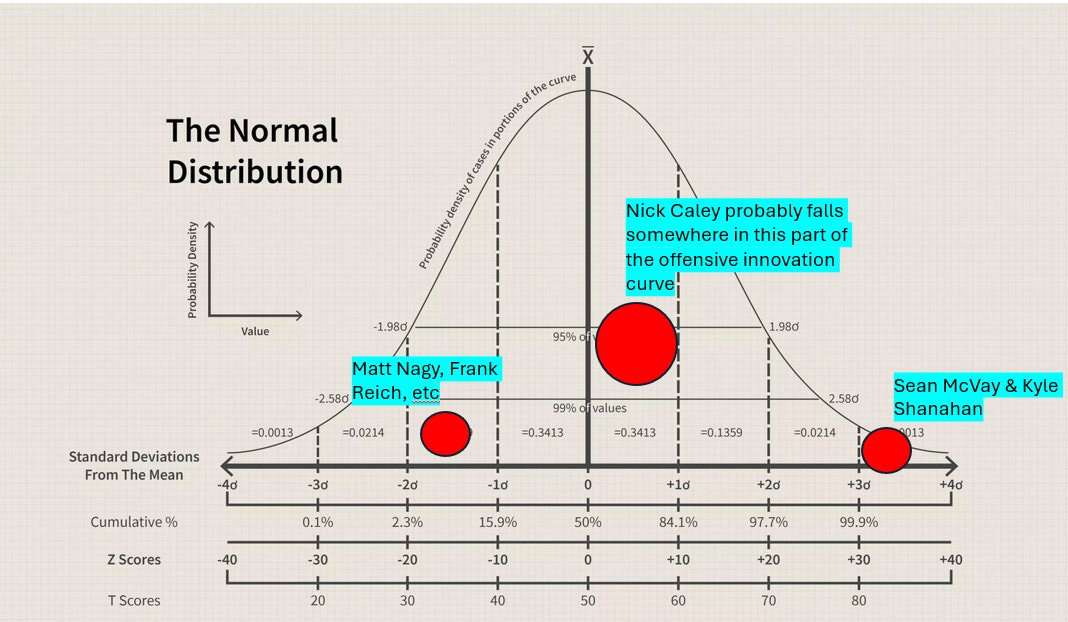
3. Caley is on the right side of the league’s offensive bell curve
The premise of Caley’s overall offensive philosophy and what they’re doing feels promising.
Houston, for example, leaned into the jumbo (6 offensive linemen) package to try to run the football and overpower smaller, nickel-oriented defenses. This was something Buffalo and Los Angeles had done a ton in 2024 so I wouldn’t call Caley an innovator in this sense but it does place him on the right side of the proverbial innovation bell curve. Globally, the league is going to continue to trend this way and I would expect further emphasis on exploiting nickel defenses in 2026. All to say, this wasn’t a dinosaur offense like we should expect to see with Frank Reich in New York this year nor an unserious college scheme like we saw in Las Vegas with Chip Kelly.
Another promising idea is that Caley does want to put more on the quarterback. This is a difficult ask and we saw Stroud struggle to grow into the scheme throughout the year, but it can pay dividends. Matthew Stafford and the Rams were essentially the only offense to challenge the Seattle Seahawks all season and, in addition to their ability to run the football, Stafford’s freedom to operate and process in that offense lent them further flexibility against coverages. Trying to unlock the best version of Stroud as the promised super-processor, accurate pocket passer (even if it ultimately exposes him) is Houston’s best avenue towards sustained offense.
This brings up the next point in that, to unlock your quarterback, you have to support your quarterback:
4. Any offensive innovation was extremely limited by their personnel
Caley came from Los Angeles where 11-personnel (1 running back, 1 tight end) was common place in previous seasons but the Texans primarily leaned on that more so out of necessity than desire in 2025.
The tight end room was completely unserious outside of Dalton Schultz. When the team wanted to go heavy to run the ball, they were practically forced into jumbo rather than 12-personnel (1 running back, 2 tight end) to do so. To call back to earlier, Buffalo and Los Angeles transitioned from jumbo to 12 and 13 personnel packages in 2025 because jumbo greatly limits your passing ability in comparison. Unfortunately, Houston did not have a tight end group like Kincaid/Knox/Hawes or Parkinson/Higbee/Ferguson to lean on. They decided their best avenue to get bigger was to put OT Blake Fisher on the field as a 6th offensive linemen instead of TE Harrison Bryant or FB Brittish Brooks – I don’t think that’s unreasonable!
Add their inability to flex into 12 or 21 personnel with an offensive line that just wasn’t very talented and suddenly it is HARD to run the football. Despite any offensive prioritization to run the football, if you don’t have the requisite talent to physically move people, your run game is going to suffer.
I am curious to see what kind of offensive ideas land on the field in Houston when they have more talent on the offensive line and hopefully more depth in the tight end group next season. I’ll be curious how the running numbers turn out with a running back that can actually churn positive plays. Either of those things could allow the offense to put Stroud in more advantageous passing scenarios and ask him to do less.
Combine all of that with the potential to self-study and improve as a play caller in his second year, that leads to the next fact about Nick Caley:
5. Houston was not upgrading during the 2026 coaching cycle
Over half of the league was searching for new offensive coordinators this cycle and the offensive coaching pool, as evidenced by Cleveland Brown’s head coach Todd Monken, is absolutely picked over. There just aren’t a ton of obvious strong candidates.
To move on from Nick Caley would have meant to pray for Mike McDaniel (he wasn’t choosing Stroud over Justin Herbert), Brian Daboll (eh), Kliff Kingsbury (teams keep moving on from him for a reason) or bet on the next young guy like Nate Scheelhase (Nick Caley had his position a year ago.)
The dream offensive coordinator candidate who had experience calling plays, came from an offense that would fit Ryans’ expectations and wanted to come to Houston probably didn’t exist. The results on paper suggest that the Texans could have tried to upgrade, but I think there was some maturity to realize that wasn’t happening. This means, much to many fans’ chagrin that:
6. Betting on Caley is not unreasonable
Houston is absolutely better off betting on Year 2 of Nick Caley than what any other scenarios would have likely yielded.
Continuity for Stroud after a confidence-shaking post-season is one more asset in his corner as he tries to bounce back into Top 10 quarterback play. There were conceptual ideas in this offense that have a much better chance to be executed with better offensive line talent next season. This offensive staff has 8 months to make sure Collins can’t be schemed out of games next season and to have better contingency plans when he isn’t available. Now, the offensive staff that drafted Jayden Higgins and Jaylin Noel can actually take a breath and figure out how to use those guys (without Christian Kirk as a development road block.)
Caley having an off-season to reflect on how he calls plays is better than rolling the dice on another first time play caller. It may not be sexy and I don’t expect a ton of positive press for Caley over the off-season, but it was a good call for Houston. Have some patience and don’t be surprised if this offensive product looks a lot better next season.
This was solid. I think I would like a breakdown on how the offense can improve schematically (providing more “answers” for CJ) but really I want to see how Caserio should address the offense this offseason.
The investment decisions in terms of draft capital, trades and free agency is noticeable between the offense and defense.
Great content! Would love to see an analysis on pressure situations to get a better sense of where the Texans are challenged. For example, did the Caley offense provide good options for Stroud most of the time in high pressure situations? Did Stroud miss those options? Did the limits of the personnel take some common solutions off the table?